Vehicles Manager
How Small Contractors Replace Spreadsheets for Fleet Management
At 6:40 a.m., two foremen mark the same F-250 ready and in-shop simultaneously. Dispatch sends it to the job. The crew waits ninety minutes. Small contractors with 10–60 vehicles abandon Excel and WhatsApp threads for live readiness boards that hold one vehicle status across every yard eliminating version conflicts, double-booking, and the morning phone scramble that costs labor hours before the first job even starts.
Quick Answer: The Spreadsheet Replacement Contractors Actually Use in 2026
Small contractors are done with complicated fleet software. They need one answer: which truck can leave this morning? The solution that sticks follows a three-status model ready, shop, or due for service. That is it. No GPS coordinates. No maintenance modules with fifty fields. Just a single row per vehicle that tells the yard manager what is operational right now.
Entry pricing sits at $2.99 per vehicle per month with no multi-year contract locking you in. You are not buying hardware or signing up for a platform that requires a training session. It replaces the spreadsheet and the WhatsApp thread simple as that.
- What it replaces: Shared spreadsheets, WhatsApp groups, and whiteboard memory
- What it costs: $2.99 per vehicle monthly, billed monthly
- What it excludes: No GPS tracking, no hardware install, no ERP modules
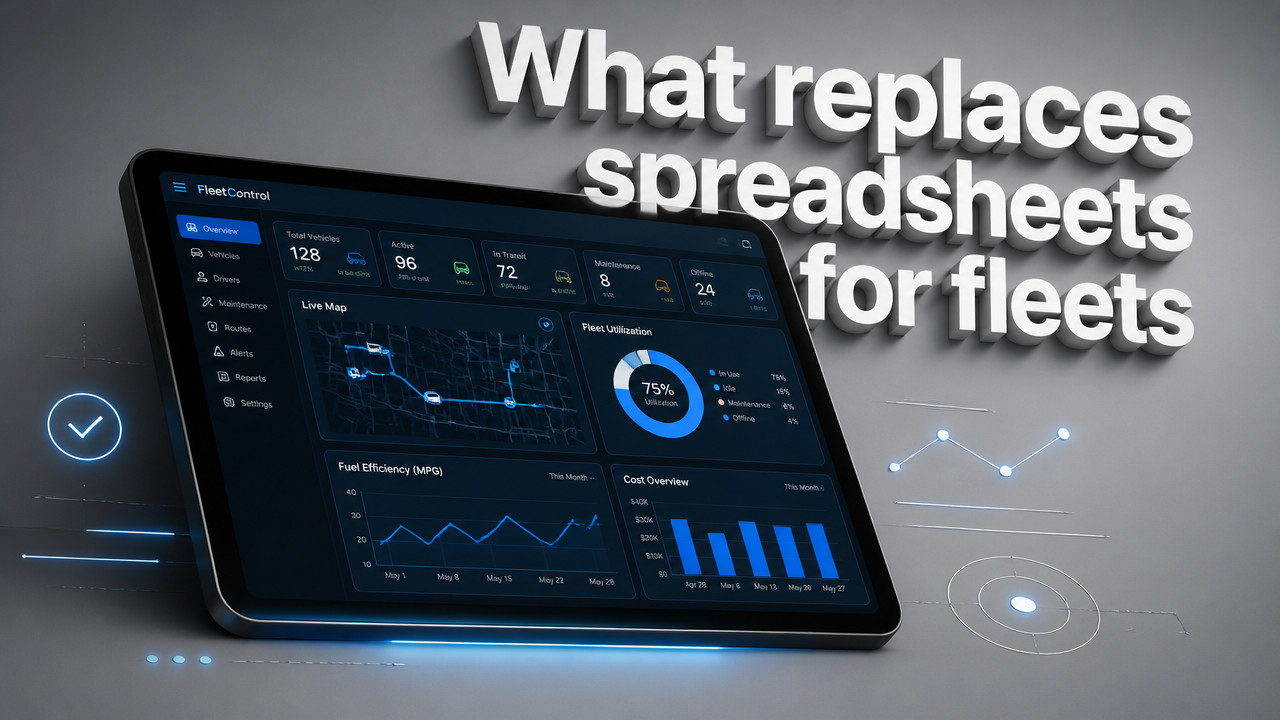
This is what a contractor fleet board actually looks like in 2026 stripped down to the one status that matters at 6:00 a.m.

Why Excel and WhatsApp Fail at Morning Roll-Out
The failure window is narrow and expensive. Between 06:00 and 07:00, the sheet goes live. Two people open it. One foreman marks the Transit 350 "ready" because the brakes came in yesterday. The shop guy marks it "in-shop" because the brake job is scheduled for this morning. Both hit save. The file that lands in dispatch depends on who saved last. That is version collision, and it happens daily.
Then there is chat burial. The WhatsApp thread moves fast. Someone messages "F-250 in shop." By 10:00 a.m., fifty messages later, that update is gone buried under parts orders, scheduling chatter, and lunch requests. Dispatch never sees it. The crew shows up at the yard to grab a van that is already on a lift.
And the sickest bottleneck? Only one person knows the sheet. When the owner or yard manager who maintains the master spreadsheet is out sick or on vacation, the whole operation slows. Nobody else knows which truck has an expired inspection sticker or which van was flagged for the transmission issue. Knowledge walks out the door.
| Failure Mode | Spreadsheet + WhatsApp | Live Readiness Board |
|---|---|---|
| Version conflict | Last save wins; overwrites prior status | Single source of truth; one status per vehicle |
| Buried messages | Shop updates lost in chat scroll | Status pinned to vehicle row; visible instantly |
| Single-owner bottleneck | Only sheet owner knows history | Any manager sees status and service record |
The trades fleet operations pattern is clear: when the morning board lives in one person's head or one person's saved file, you lose hours and jobs.
[Study] The Double-Booking Gap GPS and ERP Do Not Close
Contractors assume GPS solves this. It does not. GPS tells you where the truck is right now on the highway, at the job site, parked at the yard. It does not tell you whether that truck is cleared to leave. A van can be parked in the lot, GPS showing clean location data, while the transmission is shot and it sits waiting for a tow. That is vehicle readiness, and GPS fully ignores it.
ERP platforms go the other direction. They track everything fuel logs, depreciation schedules, parts inventory, vendor contracts. Small contractors do not need that. They need to know if the dump truck can roll. ERPs require multi-year contracts, weeks of setup, and training that pulls people off the job. The cost in time and money overshadows the problem it claims to solve.
According to Simplyfleet, small contractors are shifting from spreadsheets to specialized fleet management software that automates maintenance scheduling, real-time GPS tracking, and compliance documentation, reducing human error. But even specialized platforms overbuild for the 10–60 vehicle operator.
The actual need is smaller. One row per vehicle. Three states: ready, shop, due for service. A live readiness platform closes the gap between "where is it" and "can it leave" without the hardware, contracts, and setup chaos of larger systems.
How to Move Your Fleet List from Excel to a Shared Board in 15 Minutes
Switching does not require a kickoff call or a consultant. The best systems meet you where you are: staring at a spreadsheet you hate. Here is how the transition works for a contractor with 35 vehicles across two yards.
- Paste your existing list. Export your current vehicle roster from Excel VINs, unit numbers, nicknames. Drop it into the board. The system matches what you already have.
- Assign yard visibility. Tag each vehicle to a specific yard or location. Managers see only the trucks under their authority. No cross-yard confusion.
- Mark initial status. Walk the lot once. Mark each truck ready, shop, or due. That snapshot becomes your morning board baseline.
- Invite managers. Send a link to foremen, dispatchers, and shop leads. They open the board on their phones. No app store download, no account creation friction. Same board, everyone sees it.
The first month is open no card required. You prove it works before a single charge hits. After that, $2.99 per vehicle pricing kicks in. No setup project. No database to configure. Just your list, live.
[2026 Data] What Small Fleets Pay to Escape Spreadsheet Chaos
Cost comparison is not close. GPS platforms lock contractors into $20–$40 per vehicle per month, often with hardware fees and two- or three-year terms. You are paying for location tracking you may not need. ERPs cost even more and require implementation contracts.
Spreadsheets are free, technically. But the chaos has a price: crew hours burned waiting on broken trucks, jobs rescheduled because dispatch sent the wrong van, and the owner's time spent fielding morning phone calls to untangle the board. That is not zero cost. That is hidden cost.
| Solution Type | Monthly Cost per Vehicle | Contract Term |
|---|---|---|
| Spreadsheet + WhatsApp | Free (hidden: labor hours, mistakes) | No contract (ongoing chaos) |
| GPS Platform | $20–$40 | 2–3 year lock-in |
| Live Readiness Board | $2.99 | Monthly, cancel anytime |
According to Upperinc, tools like Simply Fleet and Fleetio offer mobile-first platforms tailored for small fleets (5-50 vehicles), enabling digital inspections, automated work orders, and centralized data storage without enterprise overhead. But even those platforms carry more weight than many contractors want.
The rental fleet management space especially benefits from the stripped-down approach rental lots need to know if a car can leave for a booking, not where it was three hours ago.
Cross-Yard Visibility Without Quiet Borrowing
Multi-yard contractors face a specific problem: quiet borrowing. A foreman at Yard B grabs a truck from Yard A because nobody answered the phone. The sheet at Yard A still shows the truck ready. Yard B just stole capacity. And neither side realizes until the customer asks where their delivery is.
Per-yard filtering solves this. A manager sees only the vehicles assigned to their yard. They cannot mark or pull trucks outside their scope. If they need a vehicle from another yard, the request goes through the owner or yard lead not a side-door grab from someone who saw it on the shared spreadsheet.
Vehicle records follow the truck, not the yard. Service history, receipts, inspection stickers, and shop notes stay pinned to that unit. When a truck transfers yards, its data moves with it. No re-entry, no lost paperwork, no "I thought the other yard tracked that."
This structure matters for landscaping fleet coordination especially crews pull from multiple lots, and equipment moves seasonally. The readiness board holds the line on who authorized what.
The Trigger Event: When Owners Finally Replace the Sheet
Owners do not switch because software looks cool. They switch because something broke. The trigger event is usually the same story: a van marked "shop" still left the yard at 06:00. Crew showed up to the job. Customer called asking where the crew was. The owner found out the spreadsheet had two conflicting statuses saved.
Or the sheet owner went on vacation. The yard ran on memory and guesswork for three days. Two trucks due for state inspection missed their dates. Fines hit. The owner came back to a mess that cost more than a software subscription.
- Trigger: Van marked shop still dispatched at 06:00, crew lost half a day
- Trigger: Sheet owner out, nobody knows which trucks are cleared
- Trigger: Key booking handed to customer, then realize car is in shop
Hesitation points are predictable too. Contractors do not want another app on their phone. They assume any fleet software includes GPS tracking they do not need. They fear a setup process that feels like a database project. The right system clears all three blocks: no GPS, no contract, and a list paste that takes minutes.
- Hesitation: "Another app" fatigue on already-full phones
- Hesitation: Assumption that fleet software equals GPS and tracking
- Hesitation: Fear of a multi-week setup and onboarding project
When those blocks clear, the switch happens fast. The moving company fleet board pattern shows the same curve: trigger event creates urgency, a 15-minute setup removes friction, and the morning board stabilizes within a week.
Key Takeaways
- The three-status model (ready, shop, due) covers 100% of morning dispatch decisions for small fleets
- $2.99 per vehicle monthly pricing with no contract removes financial risk for trying it
- GPS shows location; readiness boards show permission to leave different problems
- Version conflict in shared spreadsheets causes labor loss before the first job starts
- Setup should take 15 minutes, paste your existing list, and require no card upfront
Whether you run general contractor trucks or municipal vehicle management, the principle holds: get one status per vehicle, visible to everyone who needs it, without the overhead of systems built for bigger fleets.
FAQ
Does my spreadsheet already work for fleet tracking?
No. Spreadsheets create version conflicts when two people edit simultaneously. According to morning roll-out data, the 06:00–07:00 window has the highest error rate. Live boards hold one status per vehicle no overwrite, no confusion.
Will this overlap with GPS tracking I already have?
No overlap. GPS tells you where the vehicle is. The readiness board tells you if it can leave. Location and readiness answer different questions. You can run both or skip GPS entirely.
How long does setup take?
About 15 minutes. Paste your vehicle list, assign yards, mark initial status. No hardware, no onboarding call, no card required for the first month. You test it before paying.
Can multiple yards coordinate without cross-yard confusion?
Yes. Each yard manager sees only vehicles assigned to their location. Cross-yard pulls require explicit authorization, not quiet borrowing from a shared spreadsheet.
What if I want to cancel?
Cancel anytime. Monthly billing means no multi-year lock-in. You are not stuck in a GPS-style contract that outlasts your patience.
Sun Oct 11 · Josh B